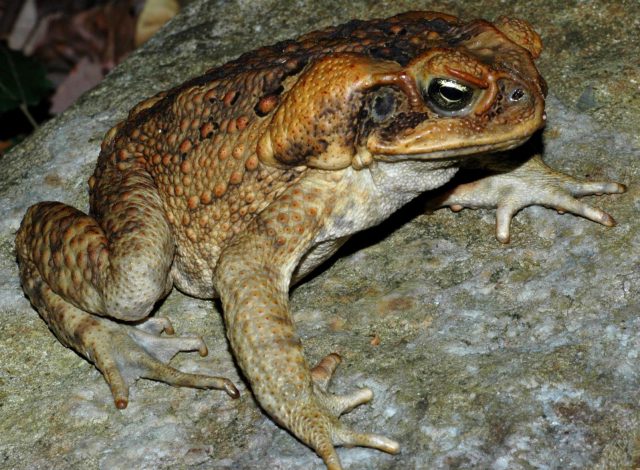
 Cane Toads(Rhinella marina) eat almost anything they can swallow, including pet food, carrion and household scrapes, but most of their food is living insects. Adult Cane Toads are active at night during the warm months of the year. During the day and during cold or dry weather they hide in moist crevice and hollows. They can survive the loss of up to 50% of their body water and can survive in temperatures from 5 degrees Celsius to 40 degrees Celsius. They are found in habitats ranging from sand dunes and coastal heath to the rain forests and mangroves, but they are most abundant in open clearings in urban areas and in grassland and woodland.
Cane Toads are native to Central and South America. They were introduced to Australia in 1935 when more than 3000 toads were released into sugar cane plantations in northern Queensland. They were meant to control the French's Cane Beetle and the Greyback Cane Beetle, which were causing damage to sugar cane crops. Unfortunately, the toad did not control the insects and became one of Australia's most highly invasive species. They currently occupy over 500,000km of Australian mainland with densities reaching up to 2,000 toads per hectare when Cane Toads first colonize a new area. They have recently spread throughout Northern Australia.
The main problems that the cane toad are causing are that when other wildlife tries to prey on them, they release a toxin from their glands that is fatal to the wildlife in Australia. The toads are poisonous at all stages of life which is a big problem for native animals in Australia. The toad is also a threat to beneficial insects such as the dung beetle and bees. Native animals also battle the cane toad for food and other resources. Diseases carried by the cane toad are also a threat to the wildlife in Australia. They also clog drains, fouling water holes, drinking troughs and swimming pools.
For many years the Australian government has funded research for a biological solution to control the cane toad. Some suggestions to rid Australia of the cane toad include using a virus to interfere with metamorphosis, the introduction of sterile males into the population, using sex pheromones to attract toads and lure them into a trap, and using a lung parasite to weaken the population. However they have not come up with the answer to the toad problem. They have also designed a fence that keeps the toads out while allowing other wildlife to pass through.
 One invasive species in America now is the Asian Citrus Psyllid (Diaphorina citri). This insect is native to Southern Asia and was introduced to the US in 1998. It possibly arrived to America on imported plants. This animal damages citrus plants by feeding on sap. It also serves as a vector for citrus greening disease which causes a decline in citrus production. They have been found throughout the Southern U.S. including Florida, Texas, Georgia, Mississippi, South Carolina and California. Some ideas to help control them are, insecticide which is shown to control the population and control the rate of spread of the disease. The goal is to reduce, but not eliminate, the psyllid population.
 Invasive species are definitely something to be concerned about. They damage the native wildlife and sometimes even cause a species to become extinct. People need to be aware that invasive species are a big problem. There needs to be more care when traveling from one place to another to make sure that invasive species are not being spread. Australia and America both have invasive species and do as much as they can to keep them under control, but something needs to be done before even more damage is caused. A solution needs to be developed to control invasive species all over the world.

No comments:
Post a Comment